.png)

Billable Time Capture: How to turn calendar + email into $50K of recovered revenue
The partner-time math that most firm owners are afraid to run. Plus the compliance-safe build path.
.png)
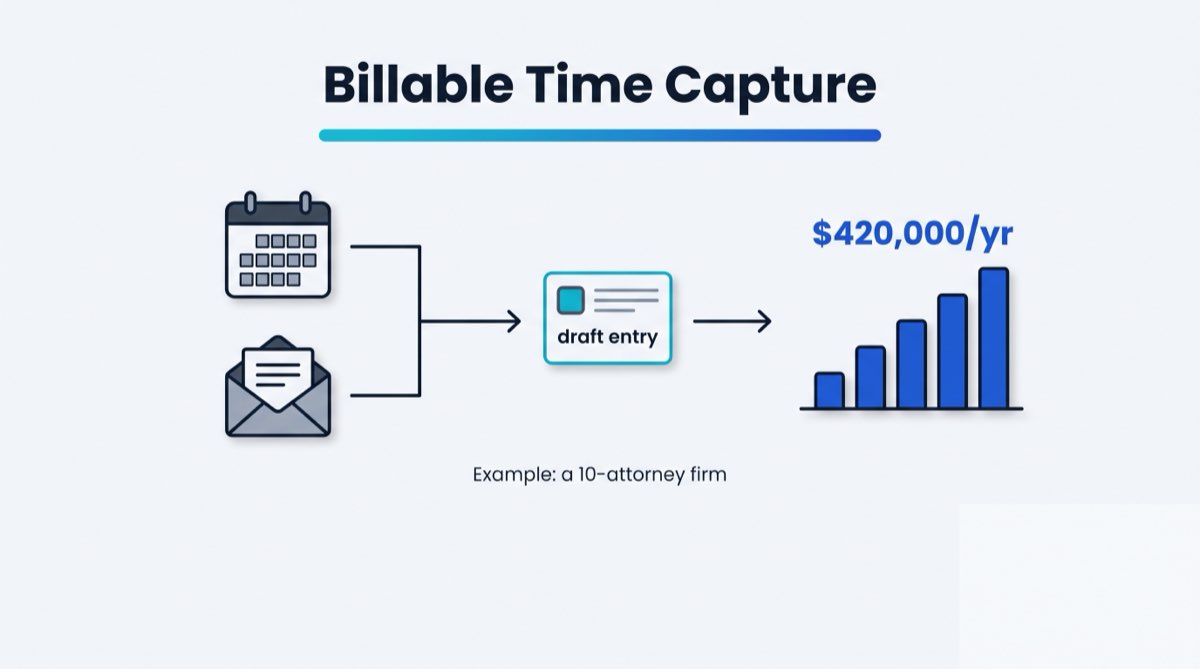
Where the hours actually go missing
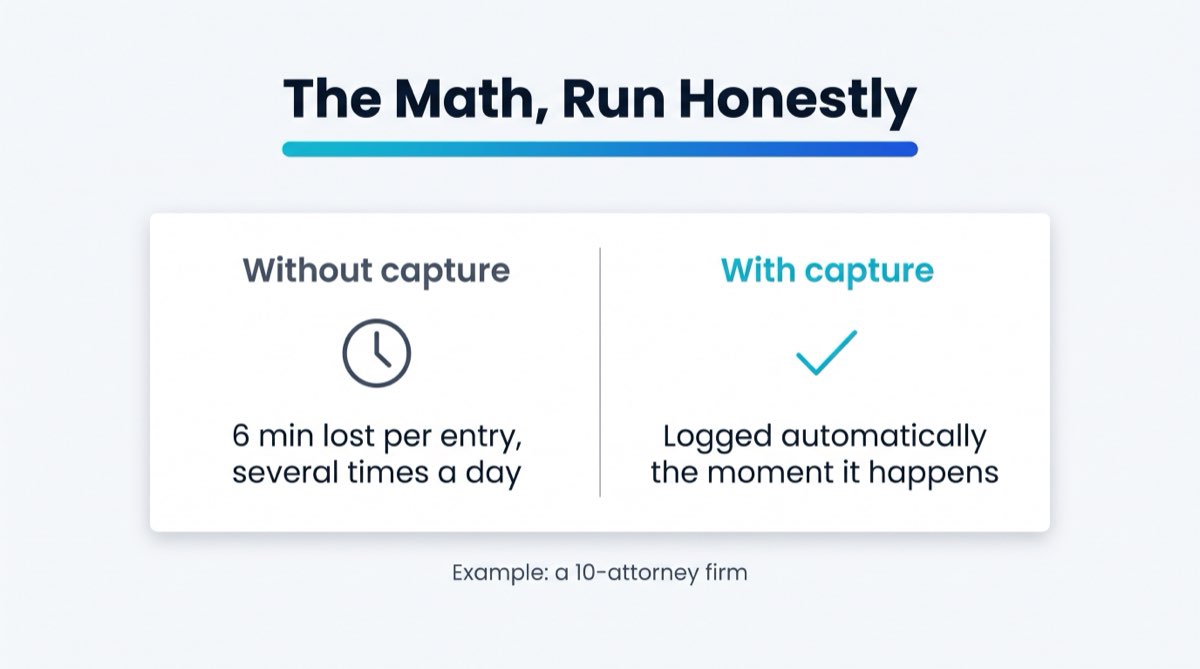
A partner takes a client call at 7:40pm from the driveway. An associate answers three emails about a filing deadline between meetings and never opens the timer. A paralegal spends twenty minutes on the phone walking a client through next steps and logs none of it, because the call wasn't on the calendar as billable work. None of that time is lost because anyone forgot to care. It's lost because remembering to start a timer for every six-minute interaction is a full-time job nobody has time for on top of the actual work.
Firms that bill hourly lose real revenue this way every week, and most owners already suspect it without being able to point to a number.
The math, run honestly
Take a 10-attorney firm billing at $350 an hour. If each attorney fails to log just 30 minutes of genuinely billable work a day, that's 5 hours a day across the firm, 25 hours a week, roughly 1,200 hours a year. At $350 an hour, that's over $420,000 in time that was worked and never billed.
Even a smaller firm, 3 partners at $300 an hour losing 20 minutes a day each, works out to about $50,000 a year in unbilled time. That's not a stretch case. It's the low end of what shows up when a firm actually reconciles calendar activity against what got invoiced.
The number moves with headcount and rate, but the pattern doesn't. The gap is never zero, and almost nobody has measured their own.
How the capture actually works
The fix isn't asking your team to try harder at logging time. It's building a system that reads what already happened and drafts the entry for a human to approve.
A typical build reads calendar events and cross-references them against your matter list or client records. Client calls, meetings, and site visits get matched to the right matter automatically. Email threads tied to a client or matter get scanned for substantive back and forth, not just automated notifications, and get flagged as a probable billable touchpoint. Each of these becomes a draft time entry with a description pulled from the actual event or thread, not a placeholder.
Nothing posts to a client invoice without a human looking at it first. The system's job is to make sure nothing gets forgotten, not to make billing decisions for you.
What stays human
The judgment calls stay exactly where they belong. Whether a call was billable, how to describe the work, whether to write off part of it for a difficult client, that's still yours to decide. What the system removes is the memory problem: the six minutes here and there that nobody captures because nobody has a system built to catch it.
Works with what you already run
This builds into Clio, Karbon, TaxDome, PracticePanther, and most practice management systems with an API or Zapier and Make support. Your team keeps using the tools they already know. The capture layer runs underneath and hands drafts to whoever approves time in your firm today.
Find your own number
The math above is illustrative. Your firm's real number depends on your headcount, your rates, and how much billable work already slips through. The Blueprint finds that number for your specific firm: 44 questions about how your operations actually run, on your own time, about 2 hours. Results come back within 24 hours, then you book an hour with Felicia to go through what it found. It's free.
Questions we get after this article
What does this actually cost?
The Blueprint is free. Answer 44 questions about how your firm runs, on your own time, about 2 hours. Results back within 24 hours, then book an hour with Felicia and RunWell team to go through them. If you want the build, the Engine is quoted after your Blueprint results come back. No subscription, no monthly retainer.
How long does a full build take?
Blueprint: your results come back within 24 hours of finishing the intake. Engine build: 4–8 weeks end-to-end, depending on automation count and stack complexity. 2-week sprints with weekly demos. No 9-month drags.


Want to see your firm's number?
10 questions. 3 minutes. A score out of 100 plus your top 3 operational gaps, with a dollar figure attached. Free. No email required to see the result.
Disclaimer. This article is for educational purposes only and does not constitute legal, accounting, tax, medical, or financial advice. References to specific compliance frameworks (ABA Model Rules, AICPA SSTS, SEC/FINRA, state bar rules) reflect the authors' and reviewers' interpretation as of the publish date and may not apply to your jurisdiction or specific facts. Consult your own licensed advisor before acting on anything written here. Statistics and case details have been anonymized; dollar figures reflect actual client outcomes as of the engagement date. RunWell is not a law firm, CPA firm, or registered investment advisor.