.png)

Why Most "AI Automation Agencies" Are Selling You a 2023 Chatbot (The Honest Vetting Guide)
Most "AI automation agencies" are chatbot builders in disguise. Use this vetting guide to identify real agentic AI implementation from glorified Zap wrappers.
.png)
The market for AI automation agencies quadrupled between 2023 and 2025. The number of agencies that can build agentic AI systems did not.
That gap is where professional firm owners get burned, whether you run a law firm, a CPA practice, a financial advisory group, a real estate team, or a marketing agency. You book a discovery call with someone who says "AI automation." You see a slick deck with GPT logos. You sign a $15,000 contract. Three months later you have a chatbot on your website and a Zap that summarizes emails, and neither one runs without someone watching it.
AI automation agency vetting is one of the most valuable due diligence skills a professional firm owner can build right now. The terminology is loose, quoted pricing spans $2,000 to $200,000, and two agencies both selling "agentic" and "intelligent automation" can be describing completely different products.
Most AI deployments in professional services never deliver measurable ROI. That gap between deployment and results is almost always a process and implementation problem, not a technology problem.
This guide gives you a framework for reading what an AI agency is selling, plus an exact vetting script you can run in any discovery call.
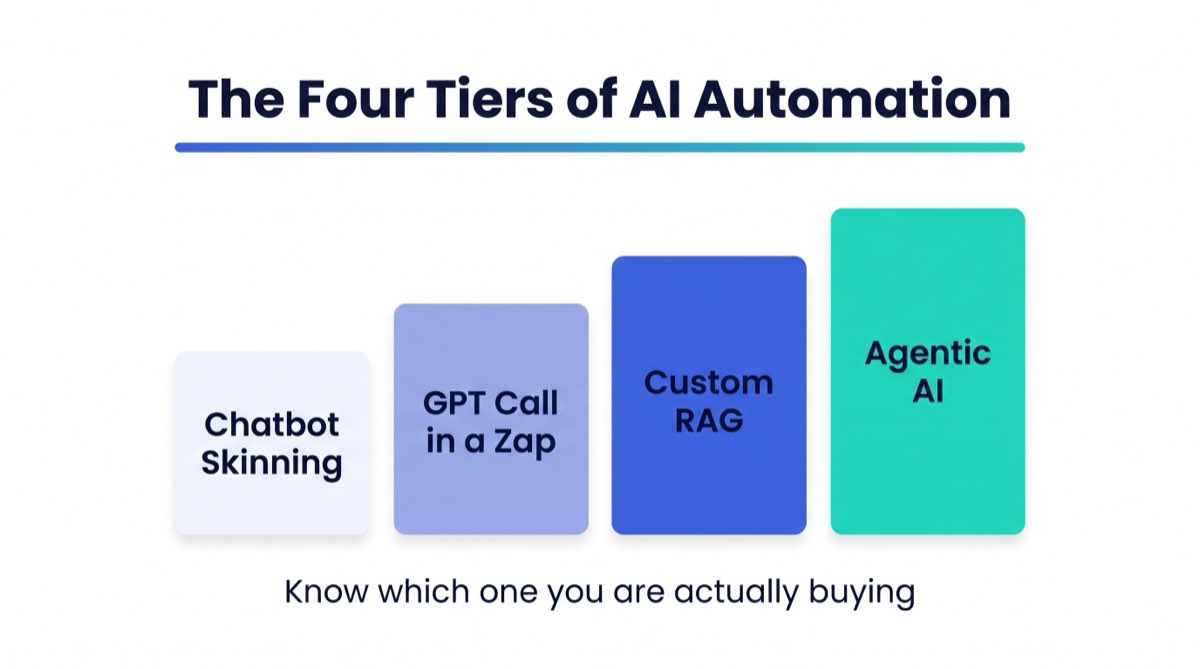
The Four Tiers of AI Automation Agencies (And Why the Difference Matters)
Not all AI automation work is the same. Before you evaluate any vendor, you need to know which tier of work they do.
Most agencies describe their work in Tier 4 language even when they're operating at Tier 1. Knowing the tiers lets you ask questions that cut through it.
Tier 1: Chatbot Skinning
A GPT wrapper with your logo on it. The vendor builds a chatbot interface, connects it to a base model like GPT-4, writes a system prompt that gives it your company's tone and a few FAQs, and calls it "an AI strategy." You can build the same thing yourself in an afternoon with ChatGPT's GPT builder.
Common sales language: "AI-powered customer experience," "intelligent FAQ automation," "conversational AI."
What you get: a text interface that answers questions. It's accurate when the answer sits in the prompt and wrong when it doesn't. No systems integration. No real-time data access. No memory across sessions unless someone explicitly built it. No exception handling.
Tier 2: GPT API Call Inside a Zap
Automation wrapped around an LLM call. The agency builds a Zapier or Make workflow that sends a request to the OpenAI API at some point and uses the response to populate a field, draft a message, or route a record. The logic around it stays deterministic and sequential. If the API call fails, or the input falls outside the training examples, the Zap breaks.
This is legitimate work and it cuts manual effort on specific, narrow tasks. It is not agentic AI. The AI does one task inside a bigger manual chain, and everything before and after that task is still a human step or a rigid rule.
Common sales language: "AI-enhanced automation," "AI-powered workflows," "intelligent Zapier automations."
Tier 3: Custom RAG
Retrieval-Augmented Generation means the AI can read a knowledge base before it responds. Your contracts, your policy docs, your historical data. This is real engineering, and a well-built RAG system answers questions against your own documents with reasonable accuracy, which is a different product from a chatbot with a system prompt.
The limitation: RAG is a read and respond architecture. The AI reads your documents and answers. It does not take action in other systems, write to records, handle exceptions, or run a workflow end to end. It reads. It does not act.
Common sales language: "AI trained on your data," "private knowledge base," "custom AI with your documents."
Tier 4: Agentic AI
This is where the category changes. An agentic system reads unstructured input, reasons across context from multiple sources, makes decisions, writes to systems of record, and handles exceptions without a human in the loop.
"Zapier kind of says, here's the right puzzle you need to use. When you work with an AI agent, it's more like, I'm going to design the puzzle for you, create all the pieces, and help you put it together."
Felicia Cristofaro, Founder of RunWell
A real agentic build for a law firm might receive an unstructured intake request by email, parse the matter type and urgency, create a matter record in your practice management system, assign it to the right attorney based on availability and specialty, send the client a scoped acknowledgment, and flag anything it cannot route confidently for human review. That whole chain runs without a human touching it, and it handles the edge cases.
That is not a Zap with a GPT call. That is a system.

Why the Terminology Is So Confused Right Now
The word "agentic" appeared in fewer than 500 business articles in January 2023. By mid-2025 it was in the marketing copy of thousands of agencies worldwide.
No certification exists. No standards body governs what an agency has to demonstrate before calling itself an "AI automation agency" or claiming expertise in "agentic AI." Anyone can use the words, and most do.
This is not a knock on the industry. There are skilled Tier 2 operators doing valuable, honest work at a price that matches it. The problem is that Tier 1 operators are charging Tier 3 prices and Tier 3 operators are using Tier 4 language.
For professional firms the cost of that mismatch is high. Your operations are multi-system, compliance-aware, and client-sensitive. A Tier 1 solution sold as Tier 4 doesn't only fail to deliver. It creates new problems the moment your team starts routing real work through a system that was never designed for real-world complexity.

What Real AI Implementation vs. Chatbot Shops Build
Here is the side-by-side on the factors that matter most to a professional firm owner.
| Factor | Tier 1–2 (Chatbot/Workflow) | Tier 3 (RAG) | Tier 4 (Agentic) |
|---|---|---|---|
| System integration depth | Surface-level API or Zapier triggers | Read-only document access | Read and write across multiple systems of record |
| Exception handling | Breaks or routes to human for any edge case | Declines to answer unknown questions | Routes exceptions intelligently, flags for human review only when needed |
| Process documentation required? | Sometimes. Often skipped. | Yes (document structure matters) | Always. Process documentation is the foundation. |
| Ongoing human oversight required? | Moderate to high | Moderate | Low. Monitoring, not management. |
| Failure mode when something changes | Breaks silently or produces wrong output | Answers become stale/incorrect | Exception handling catches most changes. Monitoring flags the rest. |
| Typical price range | $2,000–$8,000 | $10,000–$40,000 | $30,000–$200,000+ |
| Time to value | 2–4 weeks (but low ceiling) | 6–12 weeks | 90–180 days (higher ceiling) |
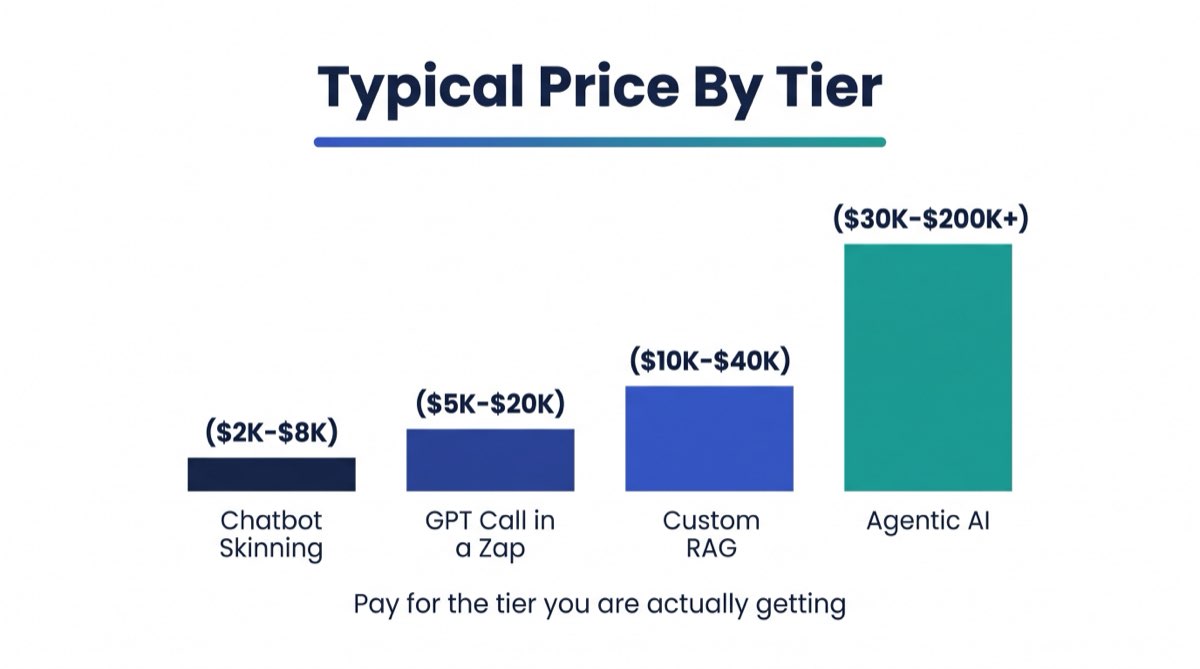
Before you evaluate any agency, decide which tier you need. A financial advisory firm with 12 advisors that wants to automate client onboarding needs Tier 4 work. A CPA firm that wants to answer "what's the status of my refund?" on its website is well served by Tier 2.
Buying Tier 2 work is not the problem. Paying Tier 4 prices for Tier 2 delivery is.
AI Agency Red Flags: What to Watch for Before You Sign
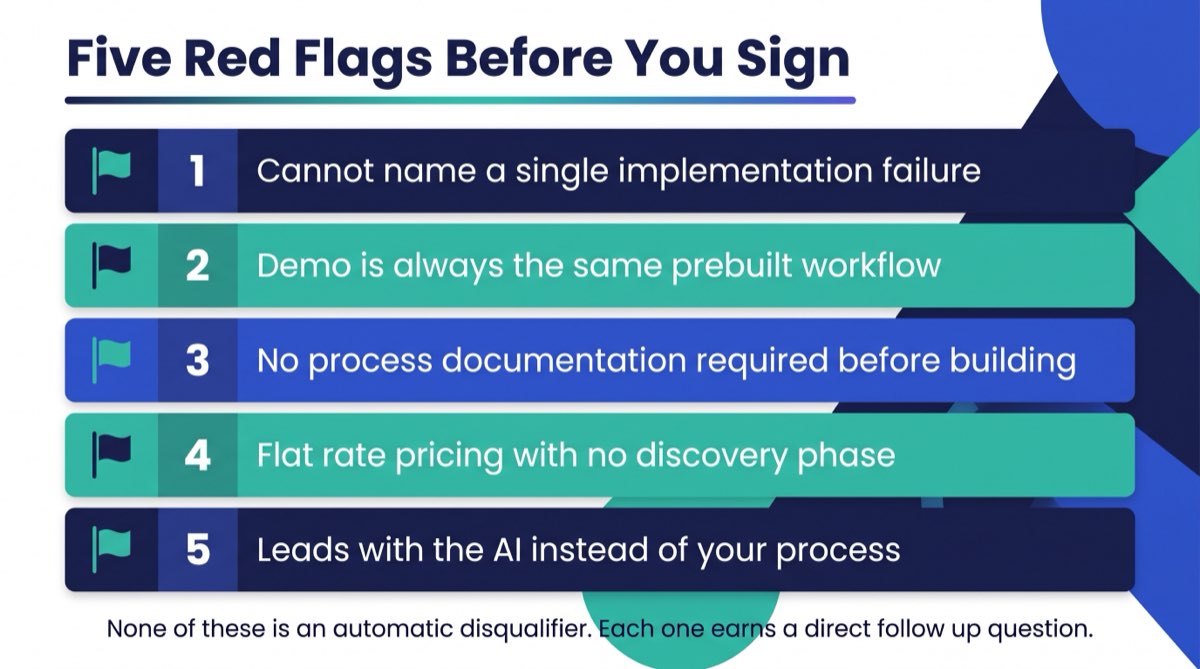
These patterns show up consistently in agencies delivering below what they sell. None of them is an automatic disqualifier. Each one earns a direct follow-up question.
They can't name a failure. Every agentic AI build hits edge cases. Every real operator has a war story about a process that looked simple and wasn't. A vendor who can't name a specific implementation that went wrong and explain what they changed either hasn't built enough to have the experience, or is selling you a version of reality with the hard parts taken out.
The demo is always the same workflow. If every discovery call ends with the same three-minute demo of a lead capture chatbot or a summarization workflow, you are looking at a Tier 1–2 shop no matter what the website says. Tier 4 builders demo the workflow you brought them, because the complexity lives in the integration, not the AI.
No process documentation requirement. An agency that quotes you a price without asking for your current process documentation is either building Tier 1–2 work, which doesn't need it, or skipping a step that will cost you later. You cannot automate a process that isn't documented. Full stop.
Pricing is flat-rate with no discovery. Agentic AI implementation cost swings hard on the number of systems involved, the complexity of the exception landscape, and the quality of your existing data. A flat-rate quote with no discovery phase is either a simple tool sold as a complex one, or a number someone made up.
They lead with the AI, not your problem. Tier 4 operators start with your process problem and show you where AI solves it. Tier 1–2 operators start with the technology and explain how it might apply to your business. That orientation tells you where their expertise lives.
The 9-Question Vetting Script for Any AI Automation Agency
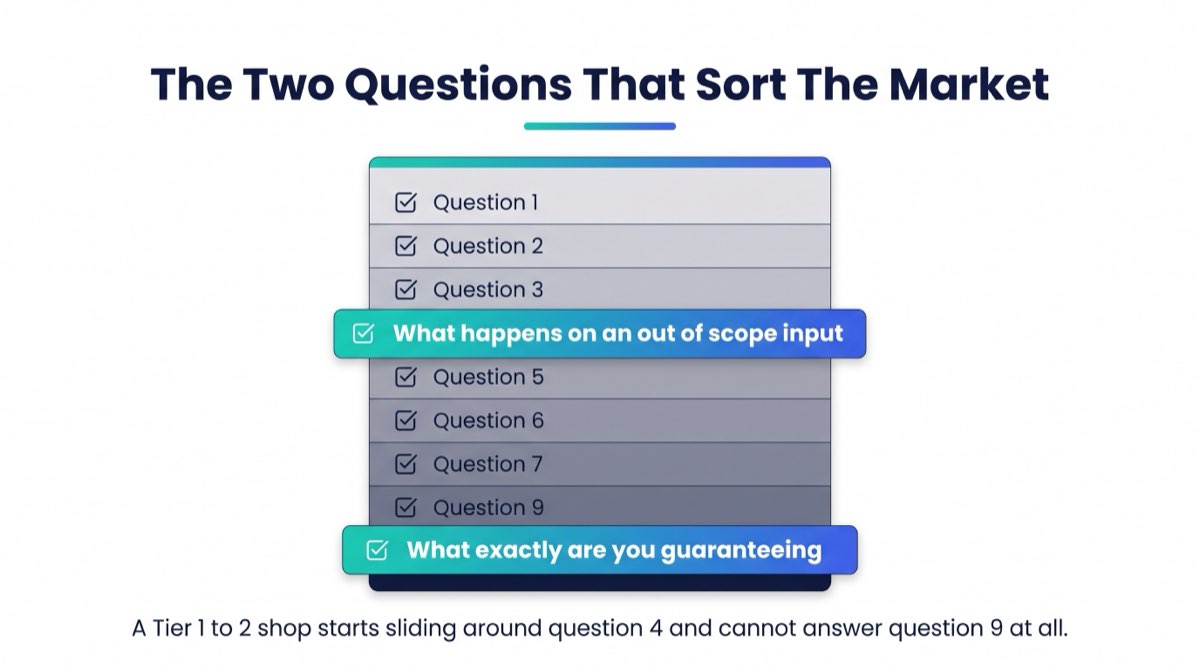
These questions are built for a 30-to-45-minute discovery call. A real agentic AI implementation agency answers every one in specific, operational detail. A Tier 1–2 shop starts sliding around question 4.
Question 1: Walk me through a client implementation that didn't go the way you expected. What broke, and how did you fix it?
Good answer: a specific story that names the integration failure point, the assumption they had wrong, and what changed in the build. The more operational detail, the better.
Red-flag answer: "Every engagement goes smoothly when we follow our process." "We haven't had any major issues." A generic story about "client change management."
Question 2: What is your process before you write a single line of code or configure any automation?
Good answer: a defined discovery or audit phase. Process mapping. Documentation of the current-state workflow. Identification of exception cases. Stakeholder interviews.
Red-flag answer: "We start with your goals and build from there." Any answer that skips documenting the current process before building the new one.
Question 3: What systems of record would this implementation read from and write to, and how do you handle authentication and data residency?
Good answer: named systems. Named authentication approaches, meaning OAuth, service accounts, or API keys. A clear answer on data handling for regulated industries.
Red-flag answer: something vague about "integrating with your existing tools." No mention of data handling for law firms, CPA firms, or financial advisory practices, where this question carries compliance weight.
Question 4: What happens when the AI encounters an input it wasn't trained on or a situation outside the defined scope?
Good answer: a defined exception handling architecture. Human-in-the-loop routing. Escalation logic. Monitoring and alerting.
Red-flag answer: "The AI learns over time." "It handles most situations well." Any answer that never describes a specific exception routing mechanism.
Question 5: How do you test the system before go-live, and what does that look like for edge cases?
Good answer: a QA process with synthetic edge case testing, real-world exception testing, and a defined staging environment.
Red-flag answer: "We test it with a few real requests before launch." No mention of edge case coverage.
Question 6: Can you show me the monitoring and alerting setup for a live implementation you've built?
Good answer: a dashboard or logging system that shows what the agent did, what it escalated, and what failed, plus proactive alerting when something falls outside expected parameters.
Red-flag answer: "You can see the Zapier history." "We check in monthly to review performance." Any answer where monitoring is reactive instead of continuous.
Question 7: What does your handoff process look like? When the engagement ends, what exactly do we own?
Good answer: complete documentation of the system architecture, credentials, process maps, and exception handling logic. Training for internal staff. A maintenance plan.
Red-flag answer: "We manage everything for you going forward," with no line between what you own and what they manage. That can be vendor lock-in by design.
Question 8: Walk me through how you would scope a project for a [law firm / CPA firm / financial advisory firm] at our scale. What would the phases look like and what's the timeline to measurable ROI?
Good answer: a scoped answer that reflects real knowledge of your industry's process complexity, compliance requirements, and typical system landscape, on a timeline that admits the documentation and testing phase takes longer than the build.
Red-flag answer: "Typically 4–6 weeks and you'll see results right away." Any timeline that leaves out process documentation and testing.
Question 9: Do you guarantee results, and if so, what exactly are you guaranteeing?
Good answer: a specific, measurable outcome tied to a defined scope. If they can't back one up, they say why and name what they will commit to instead.
Red-flag answer: a guarantee that covers everything except the thing that matters. "We guarantee satisfaction" is not a guarantee. "We guarantee the system will reduce your intake processing time by 60% or we continue working at no charge" is a guarantee.
That ninth question sorts the market fast. An agency that can't define a measurable outcome upfront hasn't built enough to know what's achievable. An agency offering a guarantee so vague it covers nothing is hoping you won't ask a follow-up. A real implementation partner tells you exactly what will change and how you'll measure it.
For Regulated Firms: Go Deeper Before You Sign
The nine questions above work for any professional firm. If you're a law firm, a CPA practice, or a financial advisory group handling client PII, privileged material, or regulated financial data, a higher-stakes engagement earns a few more questions before you sign.
Ask for their data handling and sub-processor disclosure in writing, not a verbal assurance. Ask whether they'll sign a Business Associate Agreement if any part of the workflow touches health information. Ask what happens to your data and your process documentation if the engagement ends, and whether they carry errors and omissions insurance that covers an automation failure, not just a general liability policy. Ask for a SOC 2 report or equivalent if the vendor will have standing access to your systems rather than a scoped, revocable connection.
None of this replaces the nine-question script. It extends it for the specific risk profile of a regulated firm, where a vendor's data practices are a compliance question, not just a vendor-quality one.
How to Use These Tiers to Evaluate Your Current Agency
If you're already working with an AI automation agency and you're not sure you got what you paid for, run these three diagnostics.
Ask them to produce the process map they built before implementing your automation. No process map means you paid for Tier 1–2 work, whatever you were sold.
Ask for the exception handling logs from the last 30 days, including how many inputs fell outside the expected scope and where each one was routed. If they can't answer that, your system has no exception handling. It's failing silently, or dumping work on a human without flagging itself as a problem.
Ask what happens if one of your integrated systems changes its API or updates its authentication, and have them describe the monitoring that catches it and the remediation process that follows. If the answer is "you'd notice because something stopped working," that's not an agentic system. That's a fragile Zap.
What This Means for AI Agency Due Diligence Before You Hire
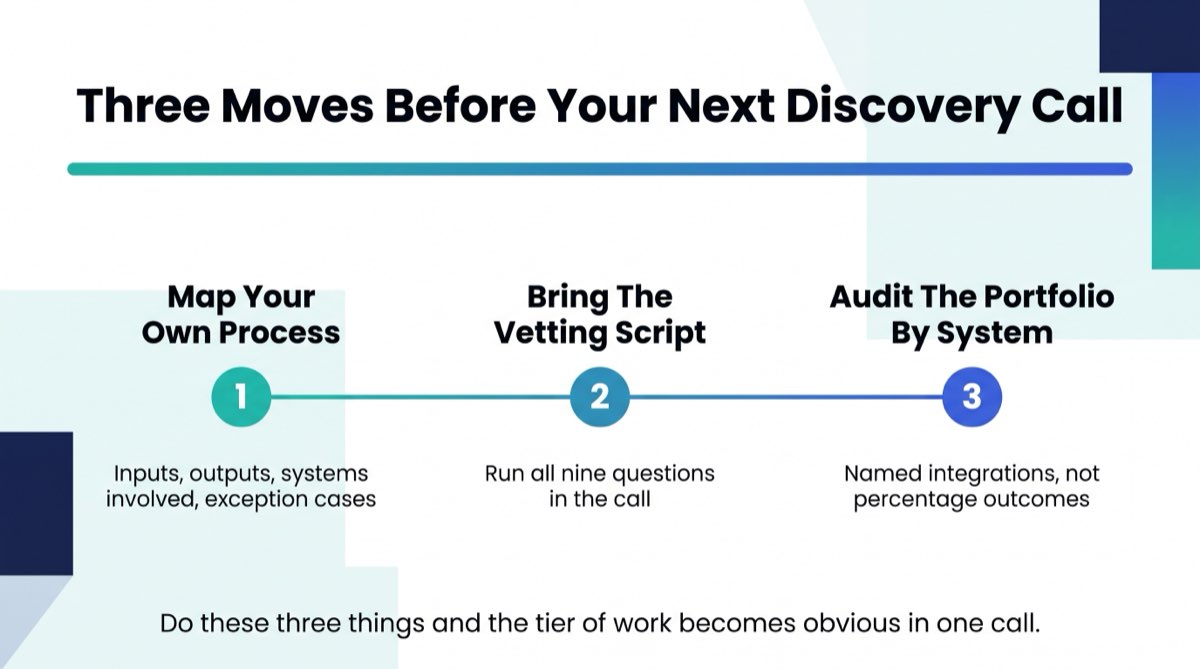
Before your next discovery call with any AI automation agency, do three things.
First, map your own process at a high level. Name the inputs. Name the outputs. Count the systems involved. List the places exceptions show up. You don't need a formal process document, you need enough specificity to tell whether the agency is engaging with your problem or handing you a template.
Second, bring the vetting script. Run the nine questions above in the discovery call. Frame them as "help me understand how you work" rather than a cross-examination. A real agency welcomes the specificity. A Tier 1–2 shop retreats into generalities.
Third, check their portfolio at the level of systems, not outcomes. "We helped a law firm reduce admin time by 40%" tells you nothing. "We integrated Clio, Outlook, and NetDocuments to automate matter creation and client communication, with exception routing to a paralegal queue" tells you what tier of work they do.
The AI automation market is real. The value is real. The terminology is being misused at industrial scale, and professional firm owners are paying for it.
"Just do the blueprint... hire someone on Upwork or Fiverr, and they should be able to do 70 to 80% of how I would do it."
Felicia Cristofaro, Founder of RunWell
If you're not sure where to start with automation, or whether your business is ready for agentic AI implementation, the RunWell Blueprint shows you where your business stands and what level of automation makes sense right now. It's free.
If you're already talking to vendors and want a second opinion on the scope and tier of work being proposed, the RunWell Blueprint starts with a full operational audit. You'll know what to build, and what to ask, before you sign anything.
What You Need to Walk Away With
The market is loud right now. Every agency with a ChatGPT account has rebranded as an AI automation company, and the terminology has outrun what most buyers understand about the technology underneath.
The four tiers exist whether or not agencies use them. The vetting questions in this guide work because they demand operational specificity that only real builders can produce.
You don't need to become an AI expert to hire the right agency. You need questions that require a specific answer, and you need to know what a specific answer sounds like next to a sales pitch.
If you want to understand your own automation readiness before you talk to anyone, the RunWell Blueprint gives you that picture. Free, no call required.
If you want someone to map your processes and tell you exactly what to build and in what order, that's what the RunWell Blueprint is for. You'll leave with a documented system map and an automation roadmap before any build work starts.
Related reading:
- Zap vs. Workflow vs. AI Agent: The $500K Automation Decision
- The AI-Era Operating System for Mid-Market Professional Firms
Frequently Asked Questions
Are AI automation agencies legit?
Many are. The problem is that "AI automation agency" covers everything from vendors building $2,000 chatbots to firms building agentic systems that write across multiple enterprise platforms. Legitimacy comes down to whether the tier of work delivered matches the tier that was sold. The nine-question vetting script in this guide surfaces that mismatch inside a standard discovery call.
What should I ask an AI automation agency before hiring them?
The four most diagnostic questions: what broke in a previous implementation and how they fixed it, what process documentation they require before building, how the system handles an out-of-scope input, and what exactly they guarantee as an outcome. Agencies doing real agentic AI implementation answer these in specific operational detail. Chatbot shops and Zap builders deflect or generalize.
Is the AI agency I'm talking to just a chatbot builder?
Look at their portfolio at the level of systems, not case study outcomes. "We automated intake for a law firm" tells you nothing. "We integrated Clio, Outlook, and a document management system with exception routing to a human queue" tells you they built a real system. If every client story ends with a chatbot or a Zap as the deliverable, you have your answer.
How do I know if an AI agency builds real AI agents?
Ask question 4 from the vetting script: what happens when the system gets an input outside its defined scope. A real agentic system has exception handling architecture. It routes edge cases, logs what it couldn't process, and alerts a person when one needs a decision. If the answer is "it handles most things well" or "you'd see it in the chat history," the system has no real exception handling and isn't agentic in any meaningful sense.
What are the red flags when hiring an AI automation agency?
Five red flags come up over and over in an AI automation agency review: they can't name a specific implementation failure, the demo is always the same pre-built workflow, they don't require process documentation before building, pricing is flat-rate with no discovery phase, and they lead with the AI technology instead of your process problem.
What's the difference between a real AI agency and a chatbot shop?
A chatbot shop builds interfaces. A real agentic AI implementation agency builds systems that read unstructured inputs, make decisions, write to systems of record, and handle exceptions without human oversight. The line isn't the AI model. It's whether the system takes action or only responds to prompts. Price is a proxy and not a reliable one, because some Tier 4 agencies are expensive and some Tier 1 shops charge Tier 3 prices.
How much should I pay an AI automation agency?
Tier 1 chatbot work runs $2,000–$8,000. Tier 2 workflow automation with LLM integration runs $5,000–$20,000. Tier 3 RAG implementations run $10,000–$40,000. Tier 4 agentic implementations for professional firms run $30,000 to $200,000+ depending on the number of systems, processes, and exception scenarios involved. At Tier 3–4 prices, run the vetting script in this guide before you sign.
How do I know if my business is ready for agentic AI?
Agentic AI implementation needs at least one documented, repeatable process with defined inputs, outputs, and exception cases. If the owner is still the primary decision-maker on most operational exceptions, the business usually isn't ready for Tier 4 work yet. A good starting point is the RunWell Blueprint, which identifies your operational readiness and the highest-value processes to automate first.
What should a regulated firm ask an AI vendor beyond the standard script?
Law firms, CPA practices, and financial advisory firms should add data-handling and compliance questions on top of the nine-question script: written data handling and sub-processor disclosure, a Business Associate Agreement if health information is involved, a SOC 2 report or equivalent if the vendor holds standing access to your systems, and errors and omissions insurance that specifically covers an automation failure. These questions matter more as the vendor's access to sensitive systems grows.
Questions we get after this article


Want to see your firm's number?
10 questions. 3 minutes. A score out of 100 plus your top 3 operational gaps, with a dollar figure attached. Free. No email required to see the result.
Disclaimer. This article is for educational purposes only and does not constitute legal, accounting, tax, medical, or financial advice. References to specific compliance frameworks (ABA Model Rules, AICPA SSTS, SEC/FINRA, state bar rules) reflect the authors' and reviewers' interpretation as of the publish date and may not apply to your jurisdiction or specific facts. Consult your own licensed advisor before acting on anything written here. Statistics and case details have been anonymized; dollar figures reflect actual client outcomes as of the engagement date. RunWell is not a law firm, CPA firm, or registered investment advisor.